10/22 Building a 20-Qubit Superconducting Processor: From Chip Fabrication to AI-Driven Bring-Up

時間:10月22日(四) 13:20 ~ 15:10

題目:Building a 20-Qubit Superconducting Processor: From Chip Fabrication to AI-Driven Bring-Up

講者:柯忠廷 助研究員

服務單位:中央研究院 物理研究所

地點:本校科學三館1樓 SC157

10/14【Special Colloquium】Probing Compact Objects: From Magnetar Activity to Accretion Dynamics

Special Colloquium

時間:10月14日(三) 16:00 ~ 17:20

題目:Probing Compact Objects: From Magnetar Activity to Accretion Dynamics

講者:胡欽評 教授

服務單位:國立彰化師範大學 物理學系

地點:本校科學三館1樓SC160

摘要:

Compact objects are natural laboratories for studying physics under extreme conditions. Starting with X-ray and gamma-ray observations, my research also draws on radio, optical, and gravitational-wave studies to understand how these systems behave. In this talk, I will focus on two questions: what causes changes in the emission of neutron stars, especially magnetars, and how compact objects interact with surrounding materials. I will first discuss our studies of magnetar emission and activity, using SGR 1935+2154 as a key example. Broadband, high-cadence X-ray observations have helped us identify glitches and track changes in its X-ray spectrum. These results help us investigate processes in the neutron-star interior and magnetosphere and explore their possible links to fast radio bursts. I will then turn to accreting compact objects, including a closer look at SMC X-1, a local analogue of ultraluminous X-ray pulsars. The evolution of its spin period and its long-term X-ray flux modulation provide clues to both the accretion flow and the geometry of the surrounding disk. Finally, I will discuss the roles of time-frequency analysis and NinjaSat observations in these studies, as well as our ongoing X-ray detector development for future observations.

10/15 Tracing Gas In and Around Galaxies with the Largest Spectroscopic Dataset

時間:10月15日(四) 13:20 ~ 15:10

題目:Tracing Gas In and Around Galaxies with the Largest Spectroscopic Dataset

講者:藍鼎文 副教授

服務單位:國立臺灣大學 天文物理研究所暨物理學系

地點:本校科學三館1樓 SC157

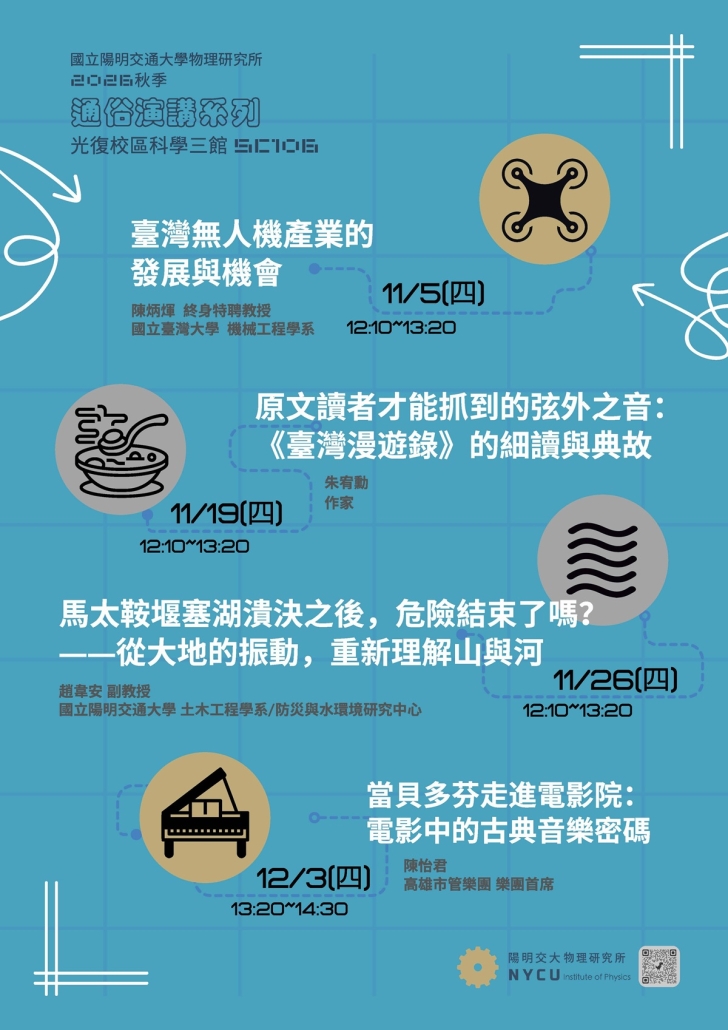
物理研究所2026秋季通俗演講系列

  • 對象:全校大學部及研究所同學(不限科系)
  • 地點:國立陽明交通大學 新竹光復校區科學三館SC106

11/5
臺灣無人機產業的發展與機會
11/5 (週四) 12:10~13:20 
陳炳煇 終身特聘教授
國立臺灣大學 機械工程學系
【摘要】從俄烏戰爭的經驗,就知道無人機對於現代戰爭國防韌性的重要,為了應付可能的無人機飽和攻擊,世界各國都在努力發展無人機產業,希望能夠建立起無人機防守跟攻擊的能力。台灣無人機的發展具備有幾項優勢,無論是晶片、感測器、或者大量製造的生產線等,台灣都在世界領先的地位,但台灣如何整合相關優勢,是否有機會成為民主國家非紅無人機最大供應鏈?

11/19
原文讀者才能抓到的弦外之音:《臺灣漫遊錄》的細讀與典故
11/19 (週四) 12:10~13:20 
朱宥勳 作家

11/26
馬太鞍堰塞湖潰決之後,危險結束了嗎?——從大地的振動,重新理解山與河
11/26 (週四) 12:10~13:20 
趙韋安 副教授
國立陽明交通大學 土木工程學系 / 防災與水環境研究中心

12/3
當貝多芬走進電影院:電影中的古典音樂密碼
12/3 (週四) 13:20~14:30 
陳怡君 高雄市管樂團樂團首席

10/8 Engineering Quantum Materials with the Cavity Vacuum: A First-Principles QEDFT Perspective

時間:10月8日(四) 13:20 ~ 15:10

題目:Engineering Quantum Materials with the Cavity Vacuum: A First-Principles QEDFT Perspective

講者:陸意德 助理教授

服務單位:國立陽明交通大學 電子物理系

地點:本校科學三館1樓 SC157

摘要:

Even without external illumination, the vacuum fluctuations of an optical cavity can reshape the ground state of a solid, offering a new route to controlling quantum materials. In this talk, I will present a first-principles framework based on quantum-electrodynamical density functional theory (QEDFT) that captures this effect in periodic systems. Starting from the Pauli–Fierz Hamiltonian in the long-wavelength limit, we incorporate electron–photon correlations into the Kohn–Sham scheme and extend density-functional perturbation theory to include photon-mediated lattice dynamics. I will show that the cavity vacuum can alter materials properties such as tune semiconductor band gaps, modify superconducting critical temperatures, and induce topological phases. These results establish QEDFT as a predictive tool for designing cavity quantum materials.


9/17 A Search for Planet Nine with IRAS and AKARI Data

時間:9月17日(四) 13:20 ~ 15:10

題目:A Search for Planet Nine with IRAS and AKARI Data

講者:後藤友嗣 教授

服務單位:國立清華大學 物理學系

地點:本校科學三館1樓 SC157

摘要:The outer solar system is theoretically predicted to harbour an undiscovered planet, often referred to as P9. Simulations suggest that its gravitational influence could explain the unusual clustering of minor bodies in the Kuiper Belt. However, no observational evidence for P9 has been found so far, as its predicted orbit lies far beyond Neptune, where it reflects only a faint amount of Sunlight. This work aims to find P9 candidates by taking advantage of two far-infrared all-sky surveys, which are IRAS and AKARI. The epochs of these two surveys were separated by 23 years, which is large enough to detect the ~3’/year orbital motion of P9. We use a dedicated AKARI Far-Infrared point source list for our P9 search – AKARI Monthly Unconfirmed Source List, which includes sources detected repeatedly only in hours timescale, but not after months. We search for objects that moved slowly between IRAS and AKARI detections given in the catalogues. First, we estimated the expected flux and orbital motion of P9 by assuming its mass, distance, and effective temperature to ensure it can be detected by IRAS and AKARI, then applied the positional and flux selection criteria to narrow down the number of sources from the catalogues. Next, we produced all possible candidate pairs whose angular separations were limited between 42′ and 69.6′, corresponding to the heliocentric distance range of 500 – 700 AU and the mass range of 7 – 17 Earth masses. There are 13 pairs obtained after the selection criteria. After image inspection, we found one good candidate, of which the IRAS source is absent from the same coordinate in the AKARI image after 23 years and vice versa. However, AKARI and IRAS detections are not enough to determine the full orbit of this candidate. This issue leads to the need for follow-up observations, which will determine the Keplerian motion of our candidate.


6/24【Special Colloquium】Experimental and Computational Physics for Several Nuclear and Radiation Applications

Experimental and Computational Physics for Several Nuclear and Radiation Applications [Part I] :
Radiation Protection, Shielding Materials, and Monte Carlo Simulations

時間:6月24日(四) 10:10 ~ 11:00 / Time:  Tuesday the 24th of June 2026, 10:10 ~ 11:00

講者:Main Speaker: Dr. Tung Hoang Nguyen
Co- Speaker: Dr. Mohamed Mitwalli

服務單位:IRC for Industrial Nuclear Energy (IRC-INE)
King Fahd University of Petroleum & Minerals (KFUPM), Saudi Arabia

地點:本校科學三館4樓 SC427會議室 / Venue: SC427, Science Building 3, NYCU

——————————————————————————————————————

Experimental and Computational Physics for Several Nuclear and Radiation Applications [Part II] :
Environmental Sustainability, Rare Element Mining, and Heritage Dating

時間:6月24日(四) 11:10 ~ 12:00 / Time:  Tuesday the 24th of June 2026, 11:10 ~ 12:00

講者:Main Speaker: Dr. Mohamed Mitwalli
Co- Speaker: Dr. Tung Hoang Nguyen

服務單位:IRC for Industrial Nuclear Energy (IRC-INE)
King Fahd University of Petroleum & Minerals (KFUPM), Saudi Arabia

地點:本校科學三館4樓 SC427會議室 / Venue: SC427, Science Building 3, NYCU
6/4 Probing Magnetar Science in the NICER Era

時間:6月4日(四) 13:20 ~ 15:10

題目:Probing Magnetar Science in the NICER Era

講者:胡欽評 副教授

服務單位:國立彰化師範大學 物理學系

地點:本校科學三館1樓 SC157

5/28 A Decade of Progress and Future Prospects in Rare Kaon Decays

時間:5月28日(四) 13:20 ~ 15:10

題目:A Decade of Progress and Future Prospects in Rare Kaon Decays

講者:林杰 助理教授

服務單位:國立彰化師範大學 物理學系

地點:本校科學三館1樓 SC157


4/30 New Frontiers in Characterizing Exoplanet Atmospheres

時間:4月30日(四) 13:20 ~ 15:10

題目:New Frontiers in Characterizing Exoplanet Atmospheres

講者:蔡尚旻 助研究員

服務單位:中央研究院 天文及天文物理研究所

地點:本校科學三館1樓 SC157

摘要:

Exoplanet science has made remarkable progress. With advancements in high-resolution spectroscopy and the launch of JWST, the field has transitioned from detection to detailed atmospheric characterization.
The diversity of exoplanets presents intriguing puzzles that challenge our theoretical understanding.
In this talk, I will review progress in exoplanet research, with an emphasis on atmospheric characterization. I will highlight some recent JWST observations, including the first evidence of photochemistry on an exoplanet. I will present the enigmatic nature of intermediate-sized planets and share insights from our recent study on temperate sub-Neptunes. I will conclude with key open questions in exoplanet characterization that are within reach of upcoming capabilities.